Tuscarawas County court docket provides a public record of cases filed within the county court system. It shows how each case moves through the court, from filing to final decision. Residents, attorneys, and researchers rely on it for reliable court records lookup. The docket lists case numbers, party names, and court divisions in one place. Many users review it to confirm hearing schedules and case status. This record supports transparency across local courts.
Tuscarawas County court docket plays a key role in tracking judicial records and legal activity. Through a Tuscarawas County case search, users can review court case records tied to civil, criminal, probate, or traffic matters. The docket information often includes legal filings, motions, and court orders. Attorneys use it for legal case tracking and preparation. Members of the public check it to stay informed about ongoing or closed cases. Official resources like the Tuscarawas County Clerk of Courts publish these records for public review.
What is a Tuscarawas County Court Docket?
A Tuscarawas County court docket is an official log of cases filed and processed in the county’s courts. It provides a structured summary of a case, including key details like parties involved, hearing dates, motions, and filings, without showing the full legal documents. For anyone needing a quick overview, the Tuscarawas County Auditor provides access to related property and tax records, making the docket the starting point for reviewing judicial records and tracking progress by case numbers.
Docket vs. Full Court Records
While often used interchangeably, a docket and full court records are not the same. The court docket is a concise record of the procedural history of a case. It lists events in chronological order, such as filings, scheduled hearings, and court rulings. Full court records, on the other hand, include complete legal documents like complaints, motions, evidence, and judgments. Think of the docket as a roadmap of a case, while full records provide every detail of the journey.
A typical Tuscarawas County docket includes:
- Case number – a unique identifier for tracking each case
- Parties involved – plaintiffs, defendants, or petitioners
- Attorneys of record – legal representatives assigned to the case
- Hearing dates – scheduled appearances in court
- Legal filings and motions – requests submitted by parties or their attorneys
- Case status updates – current stage or outcome of the case
Practical Uses of the Court Docket
Attorneys rely heavily on the Tuscarawas County court docket to manage their cases efficiently. By reviewing the docket, lawyers can confirm court dates, monitor opposing filings, and plan strategies based on upcoming motions or hearings. It also helps law firms track deadlines and avoid missed procedural steps, which is critical in civil, criminal, and family law cases. Citizens use the docket to check the status of legal matters that concern them, such as traffic violations, property disputes, or ongoing civil cases. Journalists, researchers, and other interested parties often refer to docket information to study case history, track trends in local courts, or confirm public legal actions.
How to Search Tuscarawas County Court Cases
Performing a Tuscarawas County case search allows residents, attorneys, and researchers to access court information efficiently. Whether you need to confirm a hearing date, check the status of a filing, or track procedural updates, a proper court records lookup ensures accurate and timely results.
Methods to Search Court Cases
Users can search for Tuscarawas County court cases using several methods depending on the information available:
Search by Case Number
The case number is the most precise way to locate a docket. Every civil, criminal, probate, or traffic case is assigned a unique identifier when filed. By entering this number into the official portal:
- The system retrieves all filings, motions, and scheduled hearings associated with that case.
- Users can view updates chronologically, including court schedules, motions, and judgments.
Search by Party Name
If the case number is unknown, searching by a party name—plaintiff, defendant, or petitioner—is the next best approach. Keep these tips in mind:
- Use exact spellings or known variations; middle initials can make a difference.
- Apply filters for case type (civil, criminal, probate, domestic relations) to narrow results.
- Review the list carefully; multiple results may appear for common names.
Search by Hearing Date
Users may also locate cases based on scheduled court hearings. This method works well for attorneys tracking upcoming appearances or citizens monitoring court activity. By selecting a specific date range:
- The system displays all hearings scheduled for that day.
- Users can click into individual entries to see docket information, case numbers, and parties involved.
Steps to the Official Portal
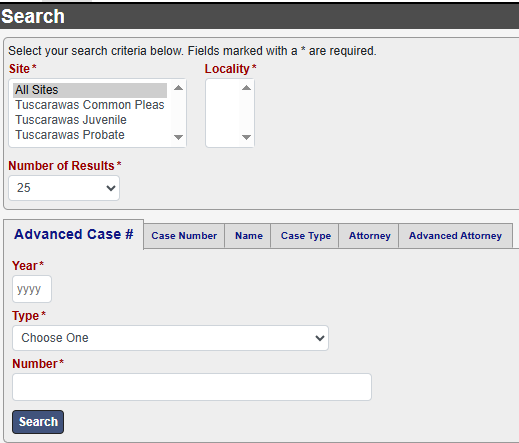
Tuscarawas County maintains an online court case search portal for public access. Follow these steps for an effective lookup:
- Navigate to the Tuscarawas County Clerk of Courts official website.
- Select “Case Search” or “Court Records Lookup” from the menu.
- Choose your search method: case number, party name, or hearing date.
- Enter the relevant information and apply filters such as court division or case type.
- Review the results table. Each entry shows case number, parties, filing date, and status.
- Click on a case number to see detailed docket information, including hearings, motions, and filings.
Digital vs. In-Person Searches
Digital searches are fast and accessible. Users can perform lookups from home or office, save records, and track updates over time.
In-person searches remain an option at the Clerk of Courts office:
- Staff can assist with physical docket books or microfilm for older records.
- In-person access may be required for restricted or sealed cases.
- Certain filings, like probate documents or sensitive domestic relations cases, may require permission to view.
Court Docket Information
A court docket may appear technical, but it follows a predictable structure that becomes clear with basic explanation. During a court records lookup, users review hearing schedules, legal filings, and case updates presented in chronological order.
What Information Appears on a Court Docket?
A court docket functions as a case activity log that records every major step in a legal matter. It shows when documents were filed, when hearings were scheduled, and when decisions were issued. Each entry is listed by date, creating a clear timeline of events. This structure allows users to track progress without reading full legal documents. Courts rely on this system to maintain transparency and organization. For anyone reviewing public court records, the docket provides a quick procedural summary. It serves as the backbone of a case’s filing history.
Typical docket details include:
- Case number and court division
- Names of parties involved
- Assigned judge
- Scheduled hearings and trial dates
- Motions and legal filings
- Orders and judgments
| Date | Docket Entry | Description |
|---|---|---|
| 01/10/2026 | Complaint Filed | Case officially begins |
| 02/05/2026 | Motion Filed | Party requests court action |
| 03/01/2026 | Hearing Scheduled | Court proceedings schedule set |
| 04/15/2026 | Judgment Entered | Final ruling recorded |
Docket Terms
Legal terms used in docket entries follow a standard format across many courts. Recognizing these words helps readers interpret the filing history correctly. A “motion” signals that a party is asking the judge for a decision. A “continuance” means a hearing or trial date has been postponed. The “trial date” indicates when formal court proceedings will begin. A “judgment” records the final decision issued by the court. Each of these terms reflects a specific stage in the case timeline. Understanding them makes court records lookup results much easier to read.
Key terms to know:
- Motion – A written request asking the court to rule on an issue
- Continuance – A delay or rescheduling of a hearing
- Trial Date – The official date set for trial
- Judgment – The court’s final ruling
- Entry Filed – A document officially recorded by the clerk
Why Hearing Schedules Matter
Hearing schedules are one of the most critical sections of any docket. They list upcoming court dates, times, and courtroom assignments. Missing a scheduled hearing can lead to penalties, fines, or default judgments. For attorneys, reviewing the court proceedings schedule ensures proper preparation and timely filings. Clients rely on these updates to plan attendance and gather documents. Regular monitoring prevents confusion about postponed or rescheduled dates. Accurate hearing information keeps all parties aligned with court requirements.
Important hearing details include:
- Date and time of appearance
- Courtroom location
- Presiding judge
- Status changes such as rescheduled or canceled hearings
How to Interpret Filing History
The filing history provides a chronological record of every legal filing in a case. Each entry includes the date, document title, and brief description of the action taken. New entries appear as the case progresses, forming a complete procedural timeline. This structure allows users to see whether the case is active, pending trial, or resolved. Reviewing docket entries explanation helps users avoid confusion over legal language. It also shows how each motion or order affects the next stage of the case. When paired with hearing schedules, the filing history offers a full picture of case status.
For clarity, adding a labeled screenshot of a sample docket page can help users visually identify:
- Case number location
- Parties listed
- Hearing date section
- Most recent docket entries
Types of Cases in Tuscarawas County Courts
Tuscarawas County courts manage several court case categories that cover civil disputes, criminal matters, probate filings, and family issues. When conducting a Tuscarawas County case search, selecting the correct case type and entering accurate case numbers makes the process faster and more precise. Each case filed in the county receives a unique number based on its category and filing year. This structure helps organize public records and supports efficient lookup through the online case search portal. Knowing the difference between legal dispute types allows users to filter correctly and avoid reviewing unrelated results.
Civil Cases
Civil cases involve disputes between private parties where compensation or enforcement of rights is requested. These matters do not involve jail time but may result in financial judgments or court orders. Many civil cases focus on contracts, property issues, or injury claims. During a Tuscarawas County case search, users can filter by civil division to narrow results quickly. Civil case numbers typically begin with a category code that identifies the type of dispute. Most civil records remain publicly accessible unless sealed by court order. Reviewing civil docket entries helps track motions, hearings, and final judgments.
Common civil matters include:
- Contract disputes
- Personal injury claims
- Property damage lawsuits
- Landlord–tenant disagreements
Criminal Cases
Criminal cases address violations of state or local laws. Prosecutors file these cases against individuals accused of committing offenses. Criminal court case categories may include misdemeanors or felonies, depending on the severity of the charge. Case numbers in criminal matters allow attorneys and defendants to track hearings and court proceedings. Public court records typically display charges, hearing schedules, and case status. Some information may be limited to protect victims or ongoing investigations. Juvenile criminal records are often confidential under state law.
Examples of criminal matters include:
- Theft and fraud
- Assault charges
- Drug offenses
- Traffic violations
Probate Cases
Probate cases focus on estates, guardianships, and related financial or care matters. These cases help manage a person’s assets after death or appoint legal guardians for minors or vulnerable adults. Probate court case numbers are essential when searching estate filings or trust documentation. Many probate records are open to public review through the online system. Yet medical evaluations or sensitive guardianship reports may remain restricted. Filing history entries show estate administration steps and court approvals. Probate dockets often contain scheduled hearings for estate settlements.
Typical probate matters include:
- Will validation
- Estate administration
- Guardianship appointments
- Trust oversight
Family Court Cases
Family court handles domestic matters that affect households and children. These cases require careful record management because they often involve private information. Divorce proceedings, custody arrangements, and child support cases fall under this category. During a Tuscarawas County case search, users must select the domestic relations division for accurate results. Case numbers help distinguish between custody modifications and new divorce filings. Many family records are public, though sensitive details may be restricted. Protective orders and cases involving minors often contain confidential elements.
Family court matters include:
- Divorce filings
- Child custody disputes
- Child support enforcement
- Protection orders
Small Claims Cases
Small claims court resolves minor financial disputes involving lower dollar amounts. These cases follow simplified procedures and usually move faster than traditional civil cases. Case numbers assigned in small claims matters allow quick tracking through the public court portal. Most small claims records are publicly accessible. Docket entries show filing dates, hearing schedules, and final rulings. This category helps residents resolve everyday disputes without complex litigation. Small claims cases form an important part of local court activity.
Common small claims disputes include:
- Unpaid debts
- Security deposit disagreements
- Minor contract issues
Public vs. Confidential Records
Most court case categories are part of public court records systems. Users can review case activity logs and hearing schedules through the online portal. Still, certain filings remain confidential under state law. Restricted records may include:
- Juvenile proceedings
- Sealed criminal files
- Adoption cases
- Sensitive medical documents
Accessing Historical Court Records
Older judicial records remain valuable for legal research, genealogy, and background checks. A proper court records lookup helps users find historical case records, past hearings, and archived docket entries that no longer appear in active systems. While recent cases are searchable online, older files may require additional steps. Courts follow retention schedules that determine how long records stay digital before moving to archives. Using a GIS Map can help visualize property-related cases and locations, making searches more efficient. Knowing where and how to search saves time and avoids confusion. Accurate case details improve success when requesting older documents.
How to Find Historical Case Records
Historical court files may not always appear in the standard online search portal. Many older cases are transferred to legal archives after a set number of years. If a case does not show up in an online court records lookup, it may still exist in archived form. Providing the correct case number, party name, and approximate year helps staff locate the file quickly. Some divisions maintain separate archive systems for probate or criminal matters. Visiting the county office may be required for very old files. Always confirm availability before traveling to the courthouse.
To locate previous court dockets, users can:
- Submit a public records request
- Visit the Clerk’s office in person
- Request archived microfilm records
- Ask for certified copies of older judgments
Retention Policies and Possible Fees
Court retention policies determine how long judicial records are preserved. Certain case types, such as felony convictions or major civil judgments, may be kept permanently. Other records may be stored for a limited period before lawful disposal. Archival storage systems help maintain older filings even after digital removal. Access rules depend on the case category and confidentiality level. Some historical case records remain fully public, while others have restricted sections. Checking retention guidelines ensures realistic expectations before submitting a request.
Possible fees may include:
- Per-page copy charges
- Certification fees for official copies
- Research assistance costs
Legal Filings and Public Notices
Legal filings form the foundation of every court case. During a court records lookup, these documents appear as docket entries that reflect each procedural step. Complaints, motions, and judgments create a structured trail of court documentation that allows users to track how a case develops over time. Legal filings are formal documents submitted to the court by parties or their attorneys. Each filing becomes part of the official case documentation and is recorded in the docket system. This process creates a transparent filing history that the public can review, unless restricted by law. When someone searches court records, they are often reviewing summaries of these filing records rather than the full documents themselves.
Common Types of Legal Filings
Every case begins with an initial filing that sets the legal process in motion. In civil matters, this document is usually called a complaint. In criminal cases, it may be a charging document or indictment. Once filed, the court assigns a case number and schedules proceedings.
Key types of legal filings include:
- Complaint – The document that starts a civil lawsuit
- Motion – A request asking the court to make a specific decision
- Answer – The responding party’s formal reply to a complaint
- Order – A directive issued by the judge
- Judgment – The final decision resolving the case
Role in Case Tracking
Legal filings serve as milestones in case tracking. Every time a document is filed, the docket updates to reflect that action. This update allows attorneys and parties to monitor deadlines and prepare for upcoming hearings. For example, after a motion is filed, the court may schedule a hearing date, which then appears in the court proceedings schedule. Public access to filing records supports transparency in the judicial system. Most filings become part of public court documentation, though sensitive information may be redacted. Sealed filings, juvenile records, and certain family court documents may remain confidential.
Public Legal Notices and Court Documentation
Some legal filings require broader public notice. Public legal notices may appear in local publications or official postings, especially in cases involving:
- Probate estate administration
- Foreclosure proceedings
- Name changes
- Government actions
Tuscarawas County Court Locations & Contact
The Tuscarawas County courthouse serves as the central hub for court filings, hearings, and public record services. Located in the heart of the New Philadelphia Ohio court district, this courthouse handles civil, criminal, and appellate matters for the county. Residents visit this location to file documents, attend hearings, or conduct a court records lookup using public access terminals. The building houses several court divisions under one roof, making it the primary site for judicial services. Visitors should confirm their specific court division before arrival to avoid delays. The courthouse maintains regular business hours for public assistance. Staff members can provide guidance on case numbers and filing procedures.
Physical Locations
The courthouse is operated through the Tuscarawas County Clerk of Courts and is located at:
101 East High Avenue
New Philadelphia, Ohio 44663
Local Court Contact Information:
- Phone: (330) 365-3243
- Website: Official Clerk of Courts online portal
- Email: Available through the Clerk’s website contact form
Public Access Hours:
- Monday – Friday
- 8:00 AM to 4:30 PM
- Closed on state and federal holidays
Frequently Asked Questions
The following frequently asked questions address common concerns about the tuscarawas county court docket, case numbers, and hearing schedules. These answers are written to help users perform a court records lookup efficiently and understand how docket information works. Reviewing these FAQs can clarify search methods, public access rules, and case tracking procedures. Each response explains practical steps and terminology used in docket entries. This section supports both first-time visitors and regular users of the online case lookup system. Clear answers improve search accuracy and reduce confusion when reviewing legal filing info.
How do I search Tuscarawas County court cases online?
To search the tuscarawas county court docket, visit the official website of the Tuscarawas County Clerk of Courts. Use the court records lookup tool and choose your preferred search method, such as case numbers, party name, or hearing date. Enter accurate details and apply filters for the correct court division. Searching by case number gives the most precise results. If using a name, double-check spelling to avoid missing entries. The system will display filing history, hearing schedules, and case status updates. Always rely on the official portal for the most current docket query results.
What information is included in a Tuscarawas County court docket?
A court docket provides a structured summary of case activity. It includes case numbers, names of involved parties, attorneys of record, and a chronological list of legal filings. Users can review motions, scheduled hearings, court orders, and final judgments. Each docket entry shows the filing date and a short description of the action taken. This case lookup format allows visitors to track progress without reviewing full documents. The docket acts as a public case activity log. It supports transparent access to court documentation.
Can I access all types of cases through a court records lookup?
Most civil, criminal, probate, and small claims matters appear in public court records systems. These court case categories typically show up during an online search. Yet certain records remain restricted under privacy laws. Juvenile proceedings, sealed files, and sensitive family matters may not be visible. Some public filings may contain redacted details for privacy protection. When performing a docket query, users should understand that confidentiality rules limit full visibility in specific cases. Contacting the Clerk’s office can clarify whether a particular case is public or confidential.
How do I interpret hearing schedules and docket entries?
Hearing schedules list upcoming court appearances, including date, time, and courtroom details. Reviewing these entries during a court schedule search helps parties prepare for attendance. Each docket entry represents a legal action such as a motion filing or judicial order. If a hearing shows “continued,” it has been postponed to a later date. A “judgment entered” note indicates the court has issued a final ruling. Reading entries in chronological order provides a clear filing history. Regular review helps prevent missed hearings or deadlines.
Are there fees for accessing Tuscarawas County court records?
Online access to docket summaries is typically free through the Clerk’s official website. Users can review case numbers, legal filing info, and hearing schedules without cost. Fees may apply when requesting printed or certified copies of court documentation. Copy charges are usually assessed per page, and certification requires an added fee. Archived case retrieval may involve research costs depending on file age. Confirming current fee policies with the Clerk’s office helps avoid unexpected expenses during a court records lookup.